Weekly Meditations for Advent
Meditating on Sacred Art
The first Sunday in Advent is the beginning on a new Liturgical Year in the Church. “Advent” means a coming, and thus, it is focussed on Christ’s Second Coming at the end of time, and His first coming, born in the stable at Bethlehem.
Advent offers us an opportunity to develop our relationship with God. Prayer is central to that relationship, but being human, we often find it difficult to pray –and often we busy ourselves with issues of the day and find there is no time for prayer. For the on-going adult education in our parish, we have produced four helpful meditations from sacred art to encourage us to enter the mystery of Advent. Also, please take an Advent book produced by the diocese after mass, which has a daily meditation for you, and parents might like to take an Advent Calendar to help their children prepare for the Coming of the Lord.
The theme for adult education in our parish for this season, beginning of the Church’s Liturgical Year is: “SACRED ART TO SUPPORT PRAYER AND MEDITATION DURING ADVENT.”
Each Sunday during Advent, paintings from sacred art will help us enter more deeply into the mystery expressed in Sacred Scripture read at Mass. Namely, the Second Coming of Christ, (1st Sunday), St John the Baptist and the fulfilment of the prophecies (2nd and 3rd Sundays).
The 4th Sunday –Our Blessed Lady and St Joseph and the immediate preparations for the Saviour’s birth.
The 2nd Sunday –8th December is also the Solemnity of the Immaculate Conception and so we shall be thinking about that mystery in connection with the birth of Christ.
Each week on the parish website there will be a study sheet on a particular painting reflecting a gospel image.
https://www.carmelite.uk.net – gives details of local and online retreats at Boars Hill, Oxford.
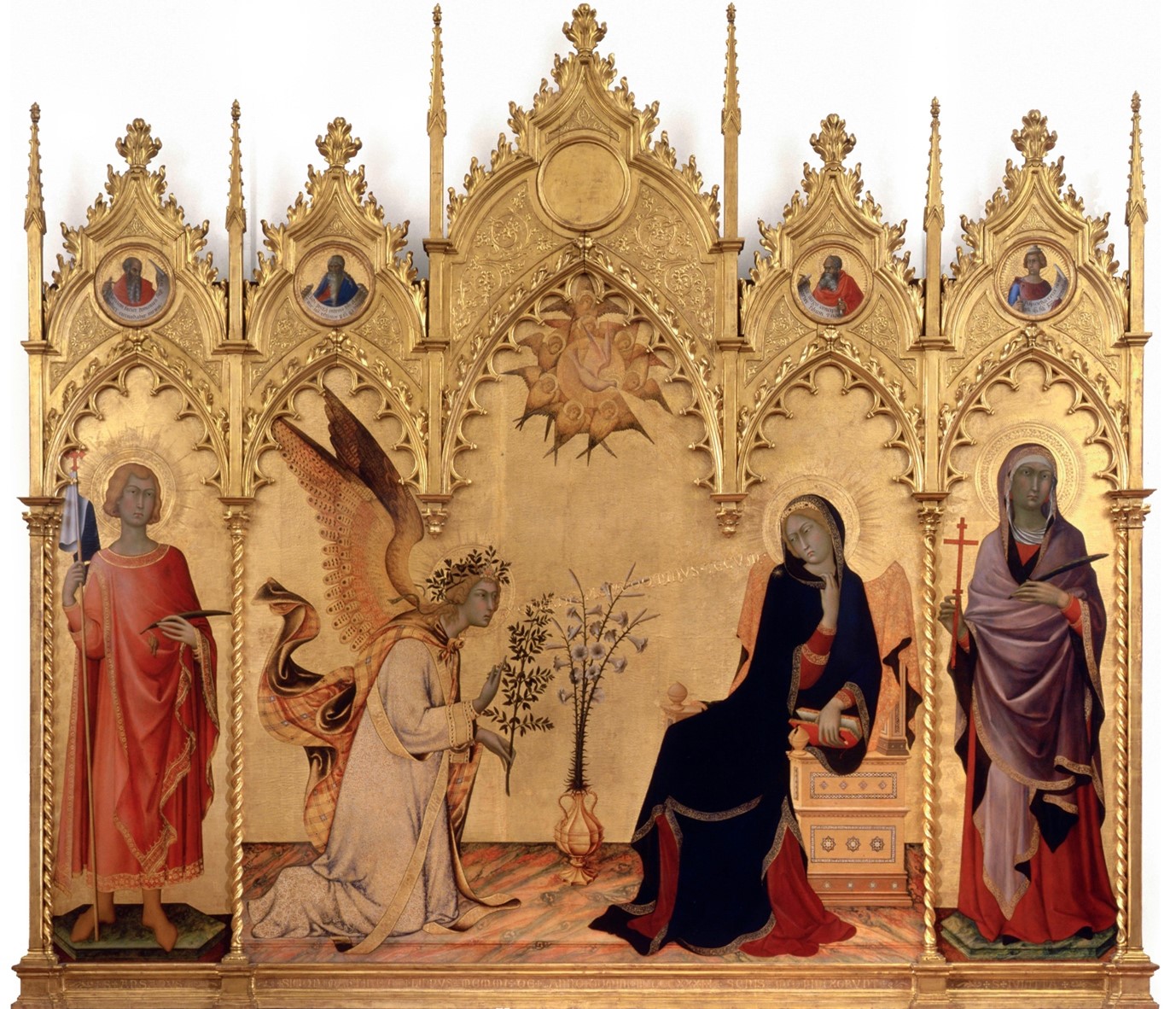
Week 1: The Annunciation - Simone Martini
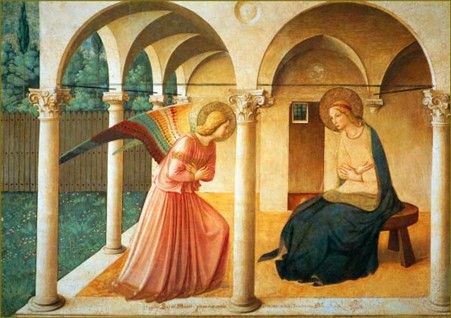
The Annunciation, Simone Martini’s signed and dated painting was completed for the altar of St. Margaret and St. Ansanus in the transept of Siena cathedral, dedicated to the Assumption of the Blessed Virgin Mary in 1333. The central panel is 10 feet wide; this online reproduction does not really reflect the imposing piece it is. The gold on the painting is real gold and there is a great deal of it. An altarpiece would be in a chapel without electric lighting. The gold was a beautiful reflective, luminous surface, and seen by candlelight would have had an otherworldly beauty. Martini captures the moment Gabriel tells the Blessed Mary that she will bear a son.
In the painting, the Archangel Gabriel appears to the Blessed Virgin Mary to tell her of the forthcoming birth of Jesus. Between the angel and Blessed Virgin Mary is a heavy golden vase with lilies bursting forth. Lilies are frequently used in Annunciation scenes and signal that Mary is pure and virginal. Between the angel and Mary are the Latin words “Ave gratia plena dominus tecum” or “Hail Mary, full of grace, the Lord is with you.” The words seem to have a living force, coming from the angel and pushing Mary back.
The words on the painting are made more significant because the prayer ‘Ave Maria’ had been gaining use at this time, so as a worshiper read the words on the altarpiece, they would also be reciting the prayer, the Hail Mary.
The angel's appearance is sudden, as suggested by the fluttering cloak and spread wings. The Blessed Mary is distressed, drawing back, and wrapping herself in her cloak.
In the painting the angel Gabriel arrives on the left. We know that he has just arrived as his cloak still swirls behind him, and he is leaning in and speaking to Blessed Mary. Gabriel’s head and neck are thrust forward into the centre arch of the work, while his wings are framed by the left-hand arch. Interestingly, the inside of Gabriel’s cloak is a plaid pattern, is this a Scottish angel? This is unlikely but there were many textile mills around this area, and plaids were known but very uncommon. All the fabrics in the painting are luxurious and expensive, and the angels resembles some used in church vestments. And the sceptre signify royalty, while the olive branch signifies peace, together they tell us that the Prince of Peace is coming. Additionally, the olive branch is associated with Noah. When Noah sent out the dove (the symbol of the Holy Spirit) and it returned with the olive branch it was a sign that God was now at peace with man and had saved Noah and his family.
The Blessed Virgin Mary in Martini’s Annunciation shrinks back into the right arch, turning away, clutching her cloak. Martini has chosen to paint the exact moment that Gabriel has swooped into the room. Is this Mary’s initial reaction to the angel appearing? She had been reading, the Bible or a devotional, and the book has dropped with her finger holding her place. The Blessed Virgin Mary is almost always reading in paintings of the Annunciation.
Blessed Virgin Mary’s facial expression is a little fearful, the expression of a young woman startled by the angel. It is a key focus in the work. Martini has chosen to paint her now when the angel greets her, prior to her learning that she is to carry the Messiah. At this moment her face indicates that she is perhaps a little troubled, frightened, and suspicious, all reasonable reactions for a young woman. Later in the gospel story she accepts the angel’s message and humbly submits. Perhaps making this painting of the annunciation so specific in time humanizes the Virgin at the start of her holy journey.
Her blue robe is a rich, deep tone of blue that flows in a curved, graceful line creating an elegant figure, who against the gold background, stands out. This effect highlights Mary as the central figure in the painting and our eye is drawn to her. She is seated in a chair, that resembles a throne. Around her head is a band of gold resembling a crown, that, and the chair hint at her coming role as the Queen of Heaven.
The Floral Centrepiece and Ava Maria in Martini’s Annunciation Detail of the Virgin Blessed Mary’s halo that is done into the gold leaf can only be appreciated when viewed close. Three windows, three arches are often used to signify the trinity. In the centre arch we have the dove surrounded by cherubim. The dove is the manifestation of the Holy Spirit, and we can see rays of light streaming out of the dove’s mouth straight at Mary. This image is used to convey the moment of the conception, similar images are in other Annunciations. The round space above the centre arch is believed to have had a painting of God the Father. So, the trinity would be present in this painting. God the Father looking on from above, the Holy Spirit in the form of the dove, and Jesus, now inside of Blessed Mary’s womb.
To view a YouTube video with a reflection on this Sacred piece of art click the image above.
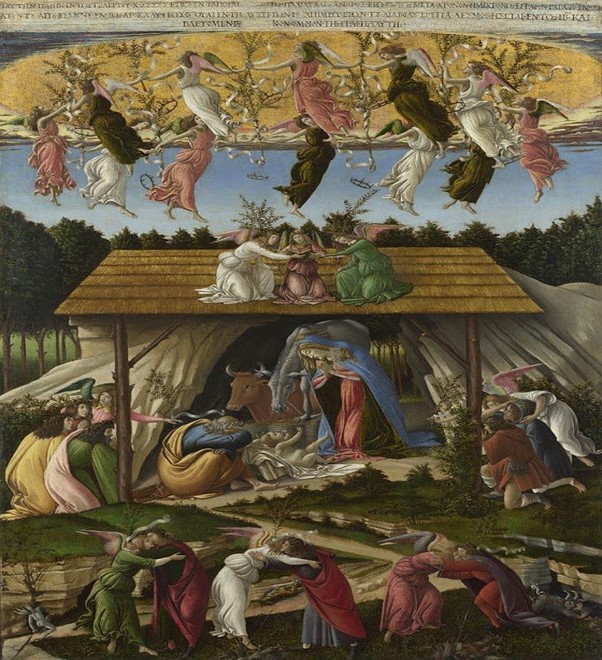
Week 2: Mystical Nativity – Botticelli
Sacred art has produced many paintings throughout time of the nativity. Idyllic pictures of the stable, with the Blessed Virgin Mary, Saint Joseph, and the Christ child, perfectly reflecting a scene of an ideal Christmas. These sacred paintings reflect a glorious expression of the joy in and gratitude for Christ’s coming.
Botticelli’s painting of The Nativity is distinctive in Sacred Art - However, this joy and anticipation of Christ’s birth, during Advent, for some on earth brings other emotions. Christmas can be a tiring and testing time, with people exhausted from the preparations, irritated by family foibles and anxiety around finances. The shining light of Christmas may reveal a darkness in the lives of some humans. Botticelli is an artist, considered by many to reveal this unseemly darkness, in his great painting of the Nativity. The Mystical Nativity is a painting in oil on canvas executed c. 1500–1501. It is in the National Gallery in London, it is his only signed work and has an unusual iconography for a painting of the Nativity.
The Scene depicts the birth of Christ, but symbols point to the Last Judgment and the Second coming of Christ - The Greek inscription at the top translates as: 'This picture, at the end of the year 1500, in the troubles of Italy. I, Alessandro, in the half-time after the time, painted, according to the eleventh chapter of Saint John, in the second woe of the Apocalypse, during the release of the devil for three and a half years; then he shall be bound in the twelfth chapter and we shall see him buried as in this picture'.
Botticelli believed himself to be living during the Great Tribulation, possibly due to the upheavals in Europe at the time, and was predicting Christ's millennium as stated in the Book of Revelation. The painting relates to the influence of Girolamo Savonarola, a significant preacher at the time who influenced Botticelli and the city of Florence in urging them to step away from their lives of excess.
So, in Botticelli’s paintings are dark premonitions – the helpless child rests on a sheet that evokes the shroud in which his body will one day be wrapped, while the cave in which the scene calls to mind, Christ’s tomb. The King on the left bear no gifts, but their own devotion.
At the sides of the painting are the shepherds.
Botticelli’s angels do more than just announce the birth of the Christ child to the shepherds, they encourage, bring them to the crib and crown the shepherds with olive wreaths. Olive wreaths would have been a feature of processions in the time Botticelli lived, a symbol of peace. Perhaps Botticelli thought that the shepherds and indeed all people need more than just an announcement of Christ’s birth, this painting seems to indicate that the shepherds and us need the encouragement and guidance by the heavenly angels.
Heaven is a great golden dome in his painting, while at the bottom of the painting three angels embrace three men, seeming to raise them up from the ground. They hold scrolls which proclaim in Latin, "peace on earth to men of goodwill". Behind them seven devils flee to the underworld, some impaled on their own weapons.
In Renaissance times, Last Judgment paintings showed viewers the reckoning of the damned and the saved at the time of Christ's Second Coming. According to art historian Jonathan Nelson, "in echoing this kind of painting the Mystical Nativity is asking us to think not only of Christ's birth but of his return".
The Three Levels in the painting - In this painting we see three levels of reality. In the centre are larger than life figures – the Blessed Virgin Mary and Saint Joseph rapt in adoration whilst Jesus opens his arms in love, then the figures of heavenly angels throughout the painting, the devils, and the humans in the centre and at the bottom of the painting.
Below the crib is a critically important part of the painting, from the deep fissures of the earth, there are creatures of darkness emerging, small devils that lurk in every psyche. But this nastiness or darkness which can threaten the joy of Christmas is driven back and defeated by the activity of the humans and angels, for Botticelli this was symbolic of all that is good in both. There are differences of distance between the humans and angels symbolising the difference between man and his ‘angel’. Botticelli here is in a gentle way pointing out we must embrace the love that Jesus makes visible. Botticelli is saying in his painting we must grasp and embrace God’s grace, we must take active steps, if we do, we will banish that dark side of all of us, that will keep us entering the presence of the new-born Lord.
The top third is the glory of the painting – Here a ring of angels, holding olive branches float and dance above the crib. The gold of heaven is behind them, and they toss crowns to earth, and musically and joyfully, in celestial peace and love celebrate the gift of the birth of Jesus, true God and true man.
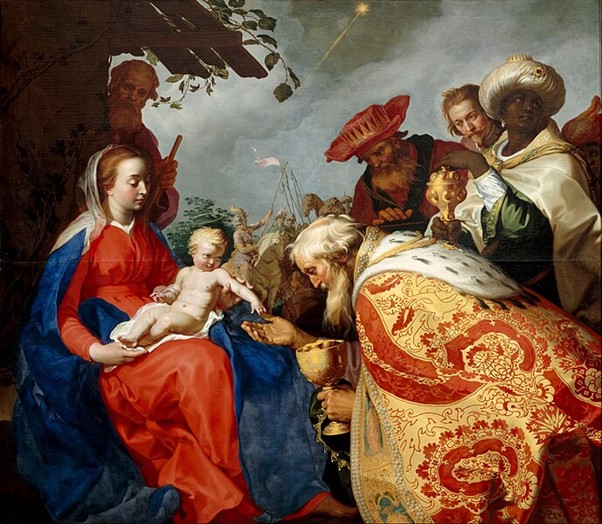
Week 3: The Adoration of the Magi – Abraham Blomaert
Depictions of events surrounding the birth of the Christ child were extremely popular in the 17th century. The adoration of Christ by the three kings was a particularly loved theme. The kings serve as multiple symbols: the three ages of man, the three races of humanity and the world’s three then known continents. Melchior, with his white skin, represents Europe; the brown Balthazar, Asia, and Caspar, depicted as a Moor, Africa. The symbolism is meant to illustrate that Christ is revealed to all humanity, young and old, and from every corner of the earth. Born on Christmas Eve in 1566 in Gorinchem, Abraham Bloemaert came from a family with artistic ties. Bloemaert’s style evolved, around 1610 his style shifted from Mannerism to a more classicising approach. In the 1620s he had a Caravaggesque phase, and in his later years he adopted some aspects of the classicism of the Carracci.
The Adoration of the Magi or Adoration of the Kings or Visitation of the Wise Men – this is the name traditionally given to the subject in the Nativity of Jesus in art in which the three Magi, represented as kings, especially in the West, having found Jesus by following a star, lay before him gifts of gold, frankincense, and myrrh, and worship him.
Matthew’s gospel only - It is related in the Bible by Matthew 2:11: "On entering the house, they saw the child with Mary his mother; and they knelt down and paid him homage. Then, opening their treasure chests, they offered him gifts of gold, frankincense, and myrrh. And having been warned in a dream not to return to Herod, they left for their own country by another path".
The submission by these earthly rulers to Jesus is clear from the painting as was using their skills, they were guided by a star to reach the Holy Family. They were the first witnesses amongst the gentiles. Look at the expression of the wise men, their clothes and then who else is in the painting possibly pointing to the darkness and danger that lay beyond the scene. The painter is perhaps too saying the star that guided the wise men is visible to all, but not all follow.
Christian iconography considerably expanded the bare account of the Biblical Magi described in the Gospel of Matthew (2:1–22). By the later Middle Ages this drew from non-canonical sources like the Golden Legend by Jacobus de Voragine. Artists used the expanded Christian iconography to reinforce the idea that Jesus was recognized, from his earliest infancy, as king of the earth. The adoration scene was often used to represent the Nativity, one of the most indispensable episodes in cycles of the Life of the Virgin as well as the Life of Christ. Stories throughout the Middle Ages started circulating, which speculated who exactly were the three kings who were famous for visiting the Christ child. Many people assumed that they came from somewhere in the east. Eventually it was decided that the three kings would represent the three main continents at the time: Europe, Asia, and Africa. The three names that prevailed over the centuries for the three kings were Gaspar (or Caspar), Melchior, and Balthasar. The prominence of this story, as well as the three kings or magi, is due to the great theological significance that the Biblical story holds, their exotic clothes and looks, as well as their great and expensive gifts. In the church calendar, the event is commemorated in Western Christianity as the Feast of the Epiphany (January 6). The Eastern Orthodox Church commemorates the Adoration of the Magi on the Feast of the Nativity (December 25).
In the earliest depictions, the Magi are shown wearing Persian dress of trousers and Phrygian caps, usually in profile, advancing in step with their gifts held out before them. These images adapt Late Antique poses for barbarians submitting to an Emperor, and presenting golden wreaths, and indeed relate to images of tribute-bearers from various Mediterranean and ancient Near Eastern cultures going back many centuries. The earliest are from catacomb paintings and sarcophagus reliefs of the 4th century. Crowns are first seen in the 10th century, mostly in the West, where their dress had by that time lost any Oriental flavour in most cases. The standard Byzantine depiction of the Nativity included the journey or arrival of the mounted Magi in the background, but not them presenting their gifts, until the post-Byzantine period, when the western depiction was often adapted to an icon style. Later Byzantine images often show small pillbox like hats, whose significance is disputed. The Magi are usually shown as the same age until about this period, but then the idea of depicting the three ages of man is introduced: a particularly beautiful example is seen on the façade of the cathedral of Orvieto. Occasionally from the 12th century, and very often in Northern Europe from the 15th, the Magi are also made to represent the three known parts of the world: Balthasar is very commonly cast as a young African or Moor, and old Caspar is given Oriental features or, more often, dress. Melchior represents Europe and middle age.
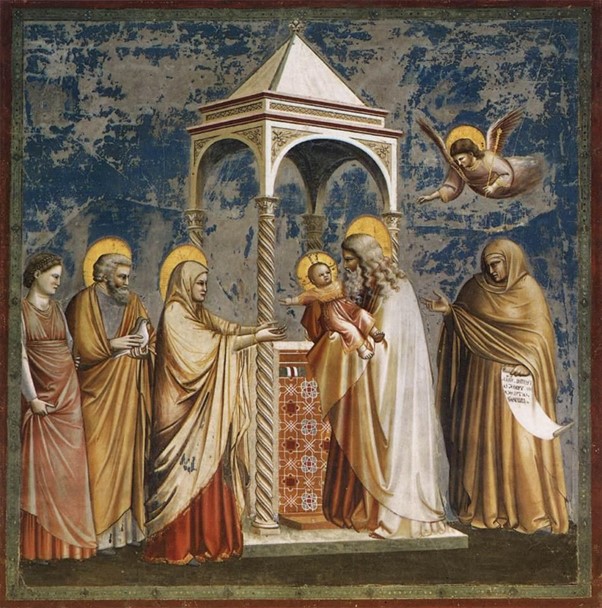
Week 4: The Presentation of Jesus in The Temple – Giotto
Luke 2
Jesus Presented in the Temple
22 When the time came for the purification rites required by the Law of Moses, Joseph and Mary took him to Jerusalem to present him to the Lord 23 (as it is written in the Law of the Lord, “Every firstborn male is to be consecrated to the Lord”[b]), 24 and to offer a sacrifice in keeping with what is said in the Law of the Lord: “a pair of doves or two young pigeons.”
25 Now there was a man in Jerusalem called Simeon, who was righteous and devout. He was waiting for the consolation of Israel, and the Holy Spirit was on him. 26 It had been revealed to him by the Holy Spirit that he would not die before he had seen the Lord’s Messiah. 27 Moved by the Spirit, he went into the temple courts. When the parents brought in the child Jesus to do for him what the custom of the Law required, 28 Simeon took him in his arms and praised God, saying:
29 “Sovereign Lord, as you have promised,
you may now dismiss[d] your servant in peace.
30 For my eyes have seen your salvation,
31 which you have prepared in the sight of all nations:
32 a light for revelation to the Gentiles,
and the glory of your people Israel.”
33 The child’s father and mother marvelled at what was said about him. 34 Then Simeon blessed them and said to Mary, his mother: “This child is destined to cause the falling and rising of many in Israel, and to be a sign that will be spoken against, 35 so that the thoughts of many hearts will be revealed. And a sword will pierce your own soul too.”
36 There was also a prophet, Anna, the daughter of Penuel, of the tribe of Asher. She was very old; she had lived with her husband seven years after her marriage, 37 and then was a widow until she was eighty-four.[e] She never left the temple but worshiped night and day, fasting and praying. 38 Coming up to them at that very moment, she gave thanks to God and spoke about the child to all who were looking forward to the redemption of Jerusalem.
39 When Joseph and Mary had done everything required by the Law of the Lord, they returned to Galilee to their own town of Nazareth. 40 And the child grew and became strong; he was filled with wisdom, and the grace of God was on him.
After the four weeks of Advent, the Christmas season stretches out gently to the feast of The Presentation of the Lord. There it ends. In this feast, there is a recognition shared by Mary and Joseph that Jesus is not ‘theirs’. But he is still their responsibility and will be for several years. We see both Simeon and Anna recognize who Jesus is. The longing and the waiting and the genuine faith of them both is portrayed in the painting. The Lord Christ has come as a baby not in a grand procession as many Jews had imagined. The painting shows Simeon handing Jesus back to his mother with her open arms. Now Simeon knows this light and salvation is for all nations.
However, the child seems afraid of this stranger and reaches towards his mother. By including this very natural reaction of a child, Giotto is emphasising the humanity of Jesus. In the scene of the Presentation, the old woman Anna stands on the right, dressed like an ancient sybil and holding a scroll of prophecy. She points us back to the centre, above both the angel concurs. The Temple is shown just as an altar with a canopy over it, fashioned in the contemporary style of the Cosmati. By angling the canopy and letting it catch the light, Giotto gives the scene credible depth but also draws our attention to the altar as the place of sacrifice and so to the Passion, which one day will come. In the chapel where this is placed there is another painting by Giotto below this one, in both scenes Christ is handed over. Above his mother has handed him over to Simeon with open arms, the painting below, Christ is handed over for his death by Judas who in the painting below embraces Jesus with his cloak.